DELIRIUM
DELIRIUM
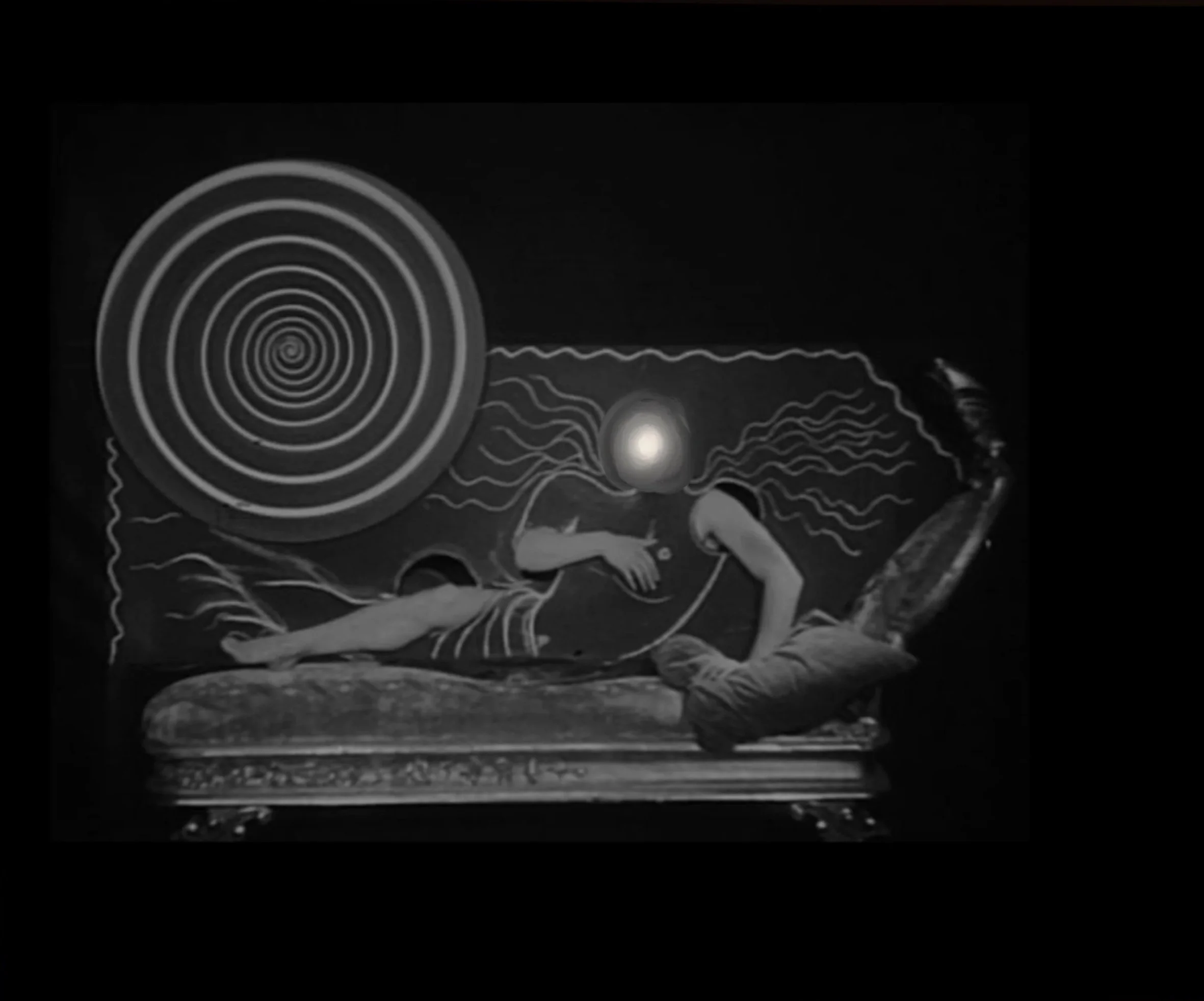
Delirium points to what might want our attention. To phenomena at the limits of perception and language. Appearing in multiple discourses without one prescribed history or meaning, delirium evokes epistemological questions, can serve as a model for crisis, and be analyzed as a formal principle. We seek to approach delirium as a productive force, and to put it to work in its relationship to politics and aesthetics. For First Forum 2026, we seek to bring our many deliriums together.
October 23-24
Lunch / First Forum Opening Remarks
Vlada Lodesk and Amy Poncher - University of Southern California

PRACTICES UNBOUND
Mad Excisions, Ife Olarewaju, University of Southern California
Seen Before: On the Déjà Vu of Synthetic Images, Firdosi Noor Nizam, Goldsmiths, University of London
Critique and/as Delirium, or: Media Theory’s Addictions, Elizabeth Berman, Brown University
Passage a L'acte in the Post-colonial milieu of Claire Denis's S'en Fout la Mort (No Fear No Die), Amira Olingou, Brown University
Respondent: Dr. Matthew Ellis

IMAGES IN TIME
Delirious Collecting: A Case Study of A Filmic Ruin in Shanghai, Ann Lyuwenyu Zhang, New York University
Speaking As a Clam: Forms of Self-Estrangement in Anelise Chen’s Clam Down, A Metamorphosis, River Ngu, Northwestern University
Anarchiving the Spectral City: Material Ethnofiction as Delirious Urban Practices, David de Rozas, University of Southern California
Becoming an Image Among Images: The Mediated Home in Post-1980’s Turkey Su Baloglu, University of Toronto
Respondent: Dr. Michael Renov
Echofract: A Chamber for Human–Machine Conversations
by Shaw Yiran Xiao and Chongyang Rao, University of California, Santa Barbara

On Reading, Criticism, and Theory
Participants: Akira Mizuta Lippit, Holly Willis, Tom Leeser, Kara Keeling
Moderator: Tania Safraz, University of Southern California

INFORMATION SLUR
Terabusters: Hollywood’s New Capitalist Delirium Disrupting the Mechanics of Circulation, and Cultural Digital Labor, Pau Brunet Fuertes, University of Southern California
Critical Climate Modeling and Capitalist Delirium: Will Postgrowth Modeling break the fever dream? Harlin/Hayley Steele, University of California, Davis
Sensitivity to Form”: Gregory Bateson qua Film Editor and the Rise of Wartime Visual Anthropology, Tara Murray, Yale University
Pynchon as Method–Delirium and Paranoia in Inherent Vice and Under the Silver Lake, Yousef Alghawi, University of Southern California
Respondent: Dr. Thomas Pringle

AESTHETICS AND POLITICS
"I am the martyr...": Constructions and (Re)Enactments of Martyrdom in Contemporary Lebanon, Reina Akkouche Halabi, University of Iowa
The Calendar of Delirium: Vanguard Time and the Colonization of Erotic Temporality in Wakamatsu Kōji's Ecstasy of the Angels (1972), Erik Yichen Tan, University of California, San Diego
Footage of What Never Happened: Generative AI and China's Unlived Pasts and Futures, Zhiyuan Tan, The New School
A Squib’s Discourse: Delirium, Diplomacy, and Death in the Action Cinema of Cannon Films, 1979-89, Ev Amaral, University of Southern California
Respondent: Dr. Nitin Govil

ENCLOSURE AS FORM, AND FORMAL ENCLOSURES
"Watch out for the crazies:" Regional Delirium Wielded Against the State in George A. Romero’s The Crazies , Rachel Pittman, University of Southern California
Fūkeiron or Landscape Theory in Masao Adachi's Red Army/PFLP: Declaration of World War (1971) and Arab Loutfi's Tell Your Tale Little Bird (1993) , Harry Ikue Mizumoto, University of California, Berkely
Dreams, Delirium, and Other Postcolonial Passions, Nisarg Patel, University of Southern California
The Secret City, Evan Michael Apodaca, University of California, San Diego
Respondent: Dr. J.D. Connor
Creative Works on Display
SCI Lobby October 19 - October 23
Thought So Lonely
Every interaction, decisions, efforts and the drama around that is driven by the force of an effort to survive or exist against the certain oppressing forces. We can see that in a complex living being such as humans and animals to vegetation to microbes to a small cell. If so, does an atomic particle also possess the same reasoning behind its nature and behaviour, and the video raises questions on what we think about consciousness in both living and non-livings, and(or) Is it just a matter of a boundary that defines that ?
Shashank S is a PhD student in the Media Arts and Technology (MAT) program at the University of California, Santa Barbara. His research and practice span physical computing, human-computer interaction, tangible media, wearable technology, and data visualization, with a particular interest in interactive systems. Shashank's work bridges technical experimentation and creative production, extending into filmmaking and experimental video art as parallel modes of inquiry.
the underloved
the underloved is a haunting 16mm film that reimagines Downtown Los Angeles through the windows of "wandering homes" that physically and conceptually move across a district shaped by erasure and redevelopment. Weaving together archival and contemporary footage, the project creates a sensory and poetic encounter, inviting viewers to experience and inhabit the district's built environment from within a ghostly shifting dwelling. Drawing on "spectral ethnography," the film treats haunting not as metaphor but as methodology—a framework for sensorially and spatially interrogating the past-present traces of lived environments rendered invisible in Downtown.
David de Rozas is a filmmaker, media artist, and educator based in Los Angeles, California. His work inquires how memory practices invoke real or imagined places, spaces, documents, or events to manifest plural ways of knowing, experiencing, and being. His films have been screened in festivals and film-curated series worldwide, such as Visions du Réel, Sheffield Doc/Fest, True/False, or Kassel DocFest. He directed and produced GIVE (2018), winning seven international awards, including Best Short Documentary at FullFrame and Best Experimental at the Smithsonian African American Film Festival. The film was nationally broadcast on P.O.V. and nominated for an Emmy under the Documentary Outstanding New Approaches category in 2019. His most recent project, The Blessings of the Mystery (2021), a collaboration with visual artist Carolina Caycedo and Juan Mancias, chairman of the Carrizo Comecrudo Tribe of Texas, inquiries into Far West Texas’ colonial and extractivist economies through native people's cosmological consciousness and resistance against ongoing forms of erasure and exploitation. This interdisciplinary exhibition premiered at The University of Texas Visual Arts Center in Austin in 2021, was on view at NY MoMA, and it will be on display at UC Santa Cruz Institute of the Arts and Sciences under the Visualizing Abolition initiative in 2023. The Blessings of the Mystery was featured at the Guggenheim Museum's The World Around public program and led to an Artist in Residency award at Headlands Center for the Arts in 2021. De Rozas has been a Flaherty Seminar Fellow (2019), VIA Art Fund Production Grantee (2020), pursuing a PhD in the Media Arts and Practice program at the University of Southern California’s School of Cinematic Arts.
Fever Dreams and Machine Hallucinations
This series is composed of digital collage dreamscapes that I physically assembled from a dataset of abstract images generated through machine hallucination using an early AI visualization program. Rather than allowing the algorithm to determine the final composition, I manually construct each uncanny scene by breaking apart hallucinated images, treating AI output as raw material to be cut, shaped, and reconfigured. I then digitally paint over parts of the image as a secondary act of embodied artistic intervention. Finally, I feed these collages into a different AI model and prompt it to animate the scenes, bringing motion to these surreal images. This process allows for a perceptual re-entering into the oneiric space of the original dream, thereby opening an altered state of consciousness between algorithmic hallucination and subconscious memory. Fever-induced visions: where bodies dissolve and spaces mutate, where AI hallucinations not only function as symbol of computational failure but as a visual state of delirium.
Julia Rose Camus is an artist and researcher working at the intersection of synthetic image culture, embodiment, and computational visuality. Her current research investigates how Al-generated imagery restructures the human body through processes of fragmentation, abstraction, and machinic recomposition. Drawing from film theory, phenomenology, body horror, and media archaeology, her work examines what happens to sensation, flesh, and materiality under increasingly synthetic visual regimes. She is currently a PhD candidate in the Division of Cinema and Media Studies at the University of Southern California. Her broader research interests include bodily representations on screen, videographic criticism, and critical/creative media practice.
The Line of Sight: Spatial Delirium at the Edge of the Knowable